CMMI : Capability Maturity Model Integration Certification | Accredify Global

CMMI - Capability Maturity Model Integration Certification | Accredify Global

What is Capability Maturity Model Integration CMMI Certification with Benefits and Types?

In today’s competitive landscape, organizations must continuously improve processes to enhance efficiency, performance, and customer satisfaction. CMMI (Capability Maturity Model Integration) Certification helps businesses optimize their processes, minimize risks, and improve project success rates.

Capability Maturity Model Integration (CMMI) is a process improvement framework that provides organizations with a structured approach to enhancing their performance. It focuses on improving processes across various domains, including development, service delivery, and acquisition. CMMI helps organizations achieve higher levels of efficiency, quality, and customer satisfaction.

The Software Engineering Institute at Carnegie Mellon University, USA, invented the CMMI model as a procedure to improve processes and ease risks related to software, product, and service development. The U.S. Department of Defence created this model to monitor the quality and capability of their software providers, but this model has inflated worldwide. Currently, the CMMI model is directed by the CMMI Institute, which was acquired by the ISACA in 2016.

Key Highlights:

  • ✔ Process Improvement: Enhances organizational processes for better performance.
  • ✔ Quality Enhancement: Improves the quality of products and services.
  • ✔ Cost Reduction: Reduces waste and improves efficiency.
  • ✔ Customer Satisfaction: Leads to higher customer satisfaction through improved delivery.
  • ✔ Competitive Advantage: Provides a competitive edge by demonstrating process maturity.

Who Needs CMMI Certification?

  • 🏢 IT & Software Development Firms – Improves software quality, project management, and service delivery.
  • 🏗️ Engineering & Manufacturing Companies – Enhances process control, efficiency, and product quality.
  • 🔍 Financial & Consulting Services – Strengthens risk management and operational efficiency.
  • 📊 Government & Defense Contractors – Ensures compliance, security, and process standardization.

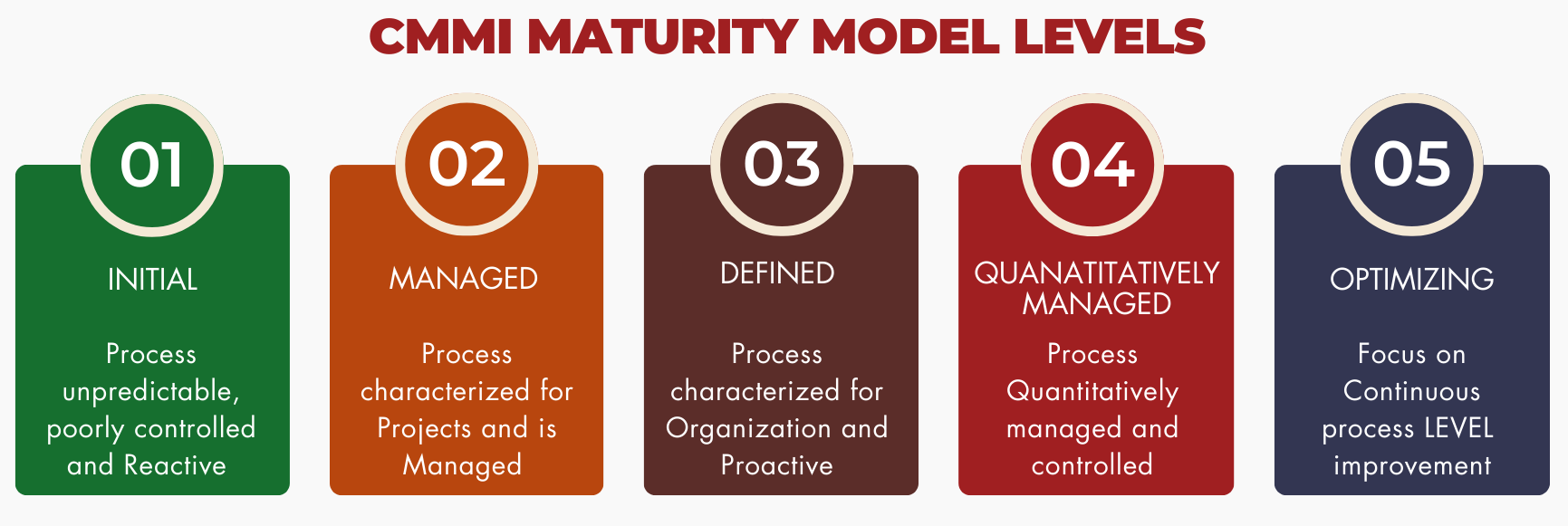
CMMI Maturity Levels

It proposes training programs for professionals and guides them to improve the organization’s development processes. It helps organizations to enhance, build and measure their performance on different parameters.

It is a conduct and procedure model that identifies and resolves process issues, minimizes risk, and promotes building a corporate culture. It addresses three areas Product and service expansion, Service building, and product and service accession.

The CMMI model incorporates multiple CMMIs and intents to deliver a single improvement framework to the industry to enhance processes and services. CMMI version 1.1 was terminated in 2002, and currently, version 2.0 is being operated by the organizations. Each version of CMMI seeks to be more coordinated and comprehensive.

1. Maturity Level 1 – Initial

  • ✅ Unpredictable processes with high risk and inefficiencies.
  • ✅ Organizations operate in a reactive mode.

2. Risk & Quality Management

  • ✅ Basic project management controls are established.
  • ✅ Organizations track performance and ensure work consistency.

3. Maturity Level 3 – Defined

  • ✅ Processes are standardized, documented, and optimized across the organization.
  • ✅ Continuous improvement strategies are implemented.

4. Maturity Level 4 – Quantitatively Managed

  • ✅ Data-driven performance measures are in place.
  • ✅ Organizations use metrics to predict project success and process improvements.

5. Maturity Level 5 – Optimizing

  • ✅ Continuous process improvement through innovation and automation.
  • ✅ Risk management and efficiency maximization.

Key Modules of CMMI Certification

1. Process Optimization & Performance Management

  • ✔ Streamlining workflows and eliminating inefficiencies.
  • ✔ Implementing best practices for software development, manufacturing, and service delivery.

2. Risk & Quality Management

  • ✔ Identifying and mitigating risks through structured processes.
  • ✔ Enhancing product and service quality with continuous monitoring.

3. Project & Resource Management

  • ✔ Effective planning, tracking, and execution of projects.
  • ✔ Reducing project failures and delays by 40%.

4. Agile & DevOps Integration

  • ✔ Aligning CMMI processes with Agile and DevOps methodologies.
  • ✔ Enhancing team collaboration and development speed.

5. Continuous Improvement & Innovation

  • ✔ Data-driven decision-making and performance optimization.
  • ✔ Encouraging innovation and process advancements.

Services

ISO 7101:2023 –Healthcare Quality Management System (HQMS ISO 9001:2015 –Quality Management (QMS) ISO 14001:2015 –Environmental Management(EMS) ISO 21001:2018 –Educational Organizations Management System (EOMS) ISO/IEC 27001:2022 –Information Security Management (ISMS) ISO/IEC 20000-1:2018 –IT Service Management (ITSM) ISO/IEC 42001:2023 –Artificial Intelligence Management System (AIMS) ISO/IEC 27701:2019 –Privacy Information Management (PIMS) ISO 45001:2018 –Occupational Health & Safety (OHS) ISO 22000:2018 –Food Safety Management (FSMS) ISO 50001:2018 –Energy Management (EnMS) ISO 13485:2016 –Medical Device Quality Management (MDMS) Certification Process Accredited Management System Process (AMSP) Complaint & Appeals Impartiality Policy Confidentiality & COI IMS (Integrated Management System) Policy Rules for Logo Use CE Marking & Product Certification HACCP (Codex 2023) – Hazard Analysis and Critical Control Points GMP (Updated 2023) – Good Manufacturing Practice Inspection and Testing General Data Protection Regulation (GDPR) Human Health Care HIPAA Compliance Certification Health Information Trust Alliance (HITRUST) System and Organization Controls (SOC) CMMI (Capability Maturity Model Integration) Vulnerability Assessment and Penetration Testing (VAPT) Payment Card Industry Data Security Standard (PCI DSS) Cyber Security Service ISO CEN/TS 16555-1:2013 - Innovation ISO/IEC 22301:2019 –Business Continuity Management (BCMS) ISO 44001:2017 – Collaborative Business Relationship ISO/IEC 17025:2017 –Testing & Calibration Laboratories ISO 20121:2012 – Sustainable Events Management ISO 41001:2018 - Facility Management ISO 55001:2014 – Asset Management System ISO 31000:2018 – Risk Management ISO 30301:2019 – Records Management System ISO 21001:2018 –Educational Organizations Management ISO/TS 16949:2016 –Automotive Quality Management ISO 21434:2021 –Automotive Cybersecurity Compliance AS 9100D:2016 – Aerospace Quality Management ISO 10002:2014 - Customer Complaint ISO 18788:2015 - Security Operation ISO 39001:2012 - Road Safety ISO 29001:2010 - QMS:Oil & Gas ISO 37001:2016 – Anti-Bribery Management System ISO 19650:2018 – Building Information Modeling (BIM) ISO 10004:2012 - Customer Satisfaction ISO 26000:2010 – Social Responsibility ISO 13485:2016 -Medical Device ISO 15189:2022 – Medical Laboratory ISO 22716:2007 – Good Manufacturing Practices (GMP) for Cosmetics

What is CMMI Level 3 Certification?

It is achieved when a business successfully meets SCAMPI A proposal, which acts as a hallmark for an organization. It must be performed by a confirmed lead appraiser, who should be in the location evaluation group.

SCAMPI A appraisal verifies that the business is operating at CMMI level 3 certification. It confirms that the industry is following all the standards and objectives.

It is an indicator of the industry’s efficiency and implies that an organization is working on all the standards set to meet Capability Maturity Model Integration ( CMMI) certification process areas and CMMI certification requirements.


What is CMMI Level 5 Certification Process ?

Level 5: Optimising- Stable and flexible

It focuses on persistent process enhancement to implement new techniques and methods that can be enforced to make the organization more efficient.

CMMI level 5 appraisal indicates that the business is at a phase of incomparable stability. It provides the organization with more flexibility to implement new objectives related to the industry’s needs. It ensures that the business is operating and executing required practices to meet process areas.

It also provides a stage for innovation and agility in the organization.


CMMI Certifications Levels Online

Capability Maturity Model Integration CMMI certification levels, also known as Maturity levels, are a set of practices that guide toward achieving a mature software process.

There are six maturity levels, and each maturity level builds on the previous one and adds new functionality to it.

  • ✅ Level 0: Incomplete -Ad hoc and unknown - Processes are usually Ad hoc and unknown.The performance depends on the individual ability as the industry does not provide a needed environment.
  • ✅ Level 1: Initial - Unpredictable and reactive - At this level, the work gets concluded, but often it takes more time and money than needed.
  • ✅ Level 2: Managed- Managed on the project level – The projects are performed, measured, and controlled at this level. It also ensures that all the requirements and services are well-planned and managed.
  • ✅ Level 4: Quantitatively Managed- Measured and controlled - It is a sub-process that significantly notifies the industry’s performance on the set objectives. It stresses support-based decision-making to enhance current and future operations.

There are six Capability Maturity Model Integration CMMI levels, but CMMI Level 3 and CMMI Level 5 certifications are the most important ones, let’s understand why.

What is Standard CMMI Appraisal Method for Process Improvement (SCAMPI)

The Standard CMMI Appraisal method for process improvement (SCAMPI) provides a framework related to the Capability maturity model. It applies to both internal and external capability determinators.

The SCAMPI family of appraisals possesses classes A, B, and C appraisal methods.

SCAMPI A: It is the only method that can result in a rating. It is one of the most rigorous methods. It confirms that the industry is following all the standards and objectives.

SCAMPI B: It is less formal than SCAMPI A as it helps to discover the objectives for the CMMI development level. It assists the industry with a superior notion to remain in the development procedure.

SCAMPI C: This is an evaluation technique. It is much shorter more adaptable and affordable.


CMMI Tools

The CMMI Institute approves outsider associations to sell CMMI apparatuses and administrations, the rundown of endorsed merchants is broad, and you can look by item, area, and language on the CMMI Institute website.

The kind of CMMI apparatuses that will work best for your association will depend upon your business needs. Following the CMMI, you’ll distinguish the best instruments during Maturity Level 2 or 3; now, your CMMI expert will offer suggestions or assist you with structuring tweaked devices based on broad inquiries. The most widely recognized class of apparatuses that you’ll have to consider incorporates:

  • ✔ Project & document-management
  • ✔ Bug-tracker
  • ✔ Estimation
  • ✔ Requirement & design-management
  • ✔ Decision & analysis tools
  • ✔ Metrics-tools
  • ✔ Integration-application

PDCA Cycle | Accredify Global

  • Plan – to think that what do we need to achieve in our organization
  • Do – to execute a planned action which will help us achieve the required objective
  • Check – monitor against the standards) (policies, objectives, requirements)
  • Action – finally implementing what has been rechecked.

ISO CERTIFICATION. 3 STEPS. 30 DAYS. DONE !! | ACCREDIFY GLOBAL

Accredify Global, we follow a structured and transparent ISO certification process to help businesses achieve international compliance efficiently. Our streamlined approach ensures a hassle-free experience from initial consultation to final certification..

3. Audit Review & Certification

  • Objective: Validate your management system through an external audit and achieve certification.
  • Actions:
    • Conduct an internal audit to ensure readiness for the certification audit, utilizing Accredify Global's auditing tools and resources.
    • Schedule and undergo an external audit with Accredify Global's accredited certification body.
    • Address any non-conformities identified during the audit with support from Accredify Global's consultants.
  • Outcome: Successful certification and ongoing compliance with the ISO standard, with continuous support and guidance from Accredify Global.